By Sara Lombera
Quartz and quartzite are easy to confuse because their names sound similar and both can appear in countertop selections. They are not the same material. Understanding the difference can help you ask better questions about appearance, performance, fabrication, and care before you commit to a surface.
Understand what the names refer to
In countertop showrooms, quartz usually refers to an engineered surface made with mineral components and binders. Quartzite is a naturally occurring metamorphic stone. Individual products differ, so a category name alone cannot tell you how a particular countertop will behave in your kitchen.
Always confirm the actual product or slab being offered. Ask for manufacturer information where applicable and make sure the estimate identifies the intended material correctly. If a photograph is the starting point, treat it as color inspiration rather than proof that a surface belongs to one category.
Compare appearance at full scale
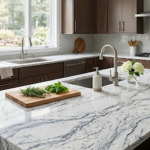
Engineered quartz is available in many patterns and colors, including relatively consistent looks and designs that resemble natural stone. Quartzite has naturally occurring variation, and its movement can change considerably across a slab. Neither description establishes what a particular piece will look like.
View a large sample or the actual selected slab when possible. Compare it with cabinet, flooring, and wall finishes. Ask which portions may be used on a prominent island or a long countertop run and whether there are likely to be seams or changes in pattern direction.
Discuss heat and impact without shortcuts
A broad claim such as ‘heatproof’ can lead to poor decisions. Engineered quartz products may have manufacturer-specific heat limitations, and resin-containing materials should not be assumed to tolerate hot cookware directly. Natural quartzite can also be damaged by thermal shock, impact, or other misuse. Use trivets, cutting boards, and common-sense protection regardless of the surface selected.
Edge and corner damage is possible with hard materials of many kinds. Rather than relying on a single durability ranking, ask how the exact product should be used, cleaned, and protected. A manufacturer’s published instructions or a stone professional’s product-specific guidance is more useful than an internet slogan.
Ask about stains, etching and cleaning
Porosity, finish, composition, and surface treatment affect maintenance. Quartzite may require sealing based on its specific characteristics, while engineered quartz care is generally directed by the product manufacturer. Do not treat either as universally stainproof or assume that all cleaners are safe.
Acids, strong chemicals, abrasive pads, and prolonged spills can create problems depending on the material. Request written care recommendations for the actual surface. Discuss what to do if a spill leaves a mark instead of trying an aggressive home treatment without guidance.
Account for the room and the fabricator
Countertop selection also involves available dimensions, sink and cooktop openings, seams, edge profiles, support, and installation sequence. An appealing sample is only one part of the decision. Ask which choices are feasible for your space and which specifications must be confirmed before templating.
Blue Sky’s portfolio of completed surfaces can help you describe preferred colors and visual movement, and its frequently asked questions provide a starting point for the process conversation. Ask for a comparison of the exact quartz product and quartzite slab under consideration, rather than treating the two names as interchangeable.